How to read a beer label: ABV, IBU, EBC, best-before date and the mentions that matter
ABV, IBU, EBC, best-before date, Trappist, bottle-conditioned: how to decode a beer label so you pick the right bottle instead of flipping a coin.
Standing in front of the beer shelf, you have two options: pick the bottle with the funniest drawing, or read the label. The first method has its fans, but it comes with surprises, like an 11% ABV imperial stout mistaken for a light late-afternoon brown ale. To read a beer label, you only need to spot a handful of details: the alcohol content, the style, the bitterness (IBU), the colour (EBC), the best-before date and a few mentions such as "bottle-conditioned" or "Trappist". Here's how to decode them.
Mandatory information: what every beer must show
In the European Union, food labelling is governed by the so-called "FIC" regulation (No 1169/2011). On a beer sold in France, you will therefore always find a common core:
- The name of the product: "beer", often followed by the style (blonde, IPA, stout…).
- The alcoholic strength by volume, shown as "% vol". This is the beer's actual alcohol content.
- The net volume: 25 cl, 33 cl, 50 cl, 75 cl…
- Allergens, especially cereals containing gluten (barley, wheat, oats…). For drinks above 1.2% vol, a full ingredient list isn't mandatory, but allergens must be declared, for example with "contains: barley". Many brewers still print the full list.
- The best-before date ("best before"), except for drinks of 10% vol or more, which are exempt.
- The batch number, plus the name and address of the business responsible for the product.
- The pregnant-woman pictogram (or an equivalent sentence), mandatory in France on alcoholic drinks.
Alcohol content: the first number to check
The "% vol" figure tells you the proportion of alcohol in the beer. It's the most useful piece of information to know what you're in for, and to pace your evening. A pilsner is often around 4 to 5% vol, a Belgian tripel or a robust IPA readily climbs to 7 to 9%, and imperial stouts or barley wines regularly go above 10%. So one 50 cl can may hold twice as much alcohol as another of the same size.
A small trap: some Belgian beers show a number in "degrees" that isn't the alcohol content but an old scale linked to the density of the wort before fermentation. When in doubt, only trust the "% vol" mention.
Style: the promise of flavour
The style is your best flavour indicator: a witbier will be light and often spiced, an IPA driven by hops, a stout roasty with coffee or cocoa notes. If style names sound cryptic, our guide to beer types goes through them one by one. A few prefixes come up often:
- Dubbel, tripel, quadrupel: in Belgium, the higher the number, the richer and stronger the beer usually is.
- Imperial: a stronger, more concentrated version of a style, like imperial stout.
- Session: a lower-alcohol version of a style, designed to be easier drinking.
- DIPA or double IPA: a hoppier, stronger IPA.
- NEIPA: a hazy, fruity IPA with softer bitterness.
IBU: the bitterness scale
IBU (International Bitterness Units) measures the amount of bitter compounds coming from hops. The higher the number, the more bitter the beer on paper. As a rough guide, a light lager often stays under 25 IBU, while many IPAs go above 40, and some go well beyond.
Bear in mind it's a lab measurement, not a measure of perception. A very malty, sweet beer can show a high IBU and still taste rounded, while a dry, light beer will seem more bitter at the same IBU. IBU isn't mandatory either: many craft breweries show it, most big brands don't.
EBC: colour in numbers
EBC (for European Brewery Convention) measures the beer's colour: the lower the number, the paler the beer. A pilsner sits at the bottom of the scale, an amber ale in the middle, a stout at the very top. On American labels you'll more often see SRM, another colour scale: an EBC value is roughly double the SRM value.
Colour says nothing about alcohol content. A black beer can be light, and a blonde can be formidable. It's the most classic mistake at the bar, and it has claimed more than one victim among fans of golden tripels.
The date: best before, not use by
"Best before" is a minimum durability date. Past that date, the beer isn't dangerous in principle, but it may have lost its aromas or its fizz. For an IPA, also look at the bottling date when it's shown: the fresher, the better. For a beer built for ageing, a few extra months are nothing to worry about. We cover all this in our article on how to store beer.
Mentions that say a lot
- Bottle-conditioned (refermentée en bouteille): a small dose of sugar and yeast was added at packaging. The beer keeps evolving and forms a sediment at the bottom. Pour it gently, leaving the last centimetre in the bottle if you prefer it clear.
- Authentic Trappist Product: this logo means the beer is brewed within the walls of a Trappist abbey, under the monks' supervision. It's granted by the International Trappist Association.
- Abbey beer: the name refers to an abbey, real or historical, but the beer may be brewed by a commercial brewery. It's not the same thing as Trappist.
- Unfiltered, unpasteurised: the beer keeps its yeast and some of its haze. It's often more lively, and more sensitive to poor storage conditions.
- Dry hopping: hops were added cold, after the boil, to bring aroma without much bitterness.
- Barrel aged: the beer spent time in a barrel that previously held wine, whisky or another spirit. Expect woody notes, and often a high ABV.
- Gluten-free: this claim is only allowed if the beer contains no more than 20 mg of gluten per kilo.
- Alcohol-free: doesn't always mean 0.0%. Check the strength shown if you really want zero.
Practice run: decode a label in thirty seconds
- 1Find the % vol: it tells you whether you're holding a thirst-quencher or a sipping beer.
- 2Read the style: it announces the flavour family.
- 3Look for IBU and EBC if they're shown: bitterness and colour, to be taken as clues.
- 4Check the date, especially for a hoppy beer.
- 5Note the special mentions: bottle-conditioned, Trappist, barrel aged…
With this grid, choosing becomes a game. It also makes a perfect basis for a beer tasting at home: have guests guess the ABV or IBU before turning the bottle around, and whoever is closest picks the next one. Think about the right glass too, explained in which glass for which beer, and why not a board inspired by our beer and cheese pairings.
And the cap, doesn't it say anything?
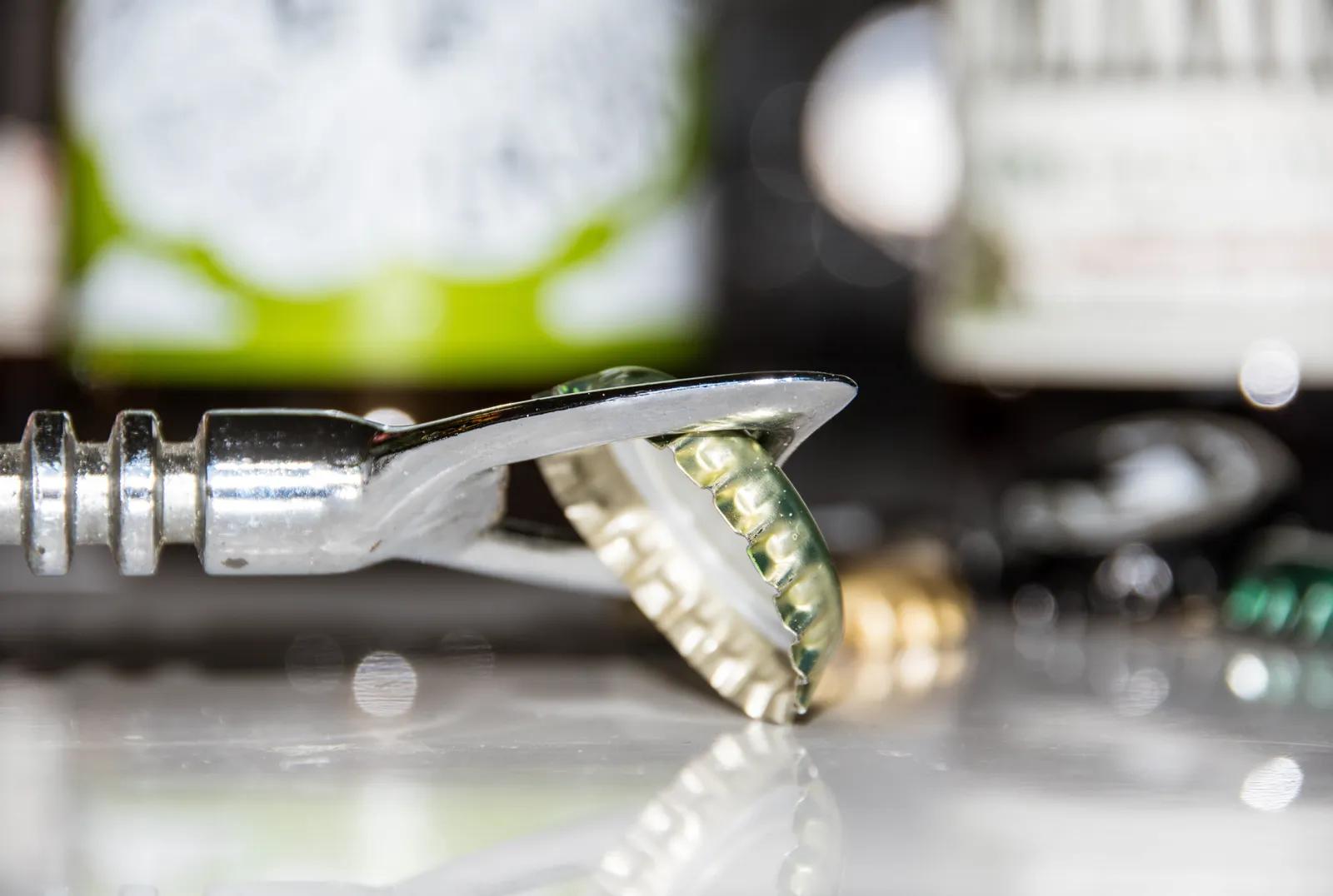
Sometimes it does: the brewery logo, a wink, a hidden message. But to read it, you have to get it off first. With the **Beer Mortar, the cap takes off* the moment the bottle opens. You can then pick it up to have a look, or add it to your collection.
Just one rule: aim at a clear area, never at people. A cap that takes off is still a small projectile, a bit like a champagne cork. The principle is explained on the how it works page.
You can read the label. Now open the bottle with style.
Discover the Beer MortarReading the label also means knowing when to stop
The "% vol" figure isn't just a connoisseur's curiosity: it's the simplest tool to know what you're drinking. A strong beer is best enjoyed in small amounts and slowly, alternate with water, and plan a way home for anyone who has been drinking. Alcohol-free beers have labels worth decoding too. Alcohol abuse is dangerous for your health; please drink responsibly.
Frequently asked questions
What does IBU mean on a beer?
IBU stands for International Bitterness Units. It measures the amount of bitter compounds from hops. The higher the number, the more bitter the beer in theory, but perception also depends on the malt and residual sugar.
What does EBC mean on a beer label?
EBC refers to the European Brewery Convention colour scale. The lower the value, the paler the beer; the higher, the darker. American labels tend to use the SRM scale, whose values are roughly half as high.
Is an ingredient list mandatory on beer?
Not for drinks above 1.2% vol in the European Union. However, allergens such as barley or wheat must be declared, and many brewers voluntarily print the full list.
Is a dark beer stronger than a blonde?
No. Colour mostly comes from roasted malts and says nothing about alcohol content. Only the "% vol" mention on the label shows the actual strength.
What's the difference between Trappist beer and abbey beer?
A beer bearing the Authentic Trappist Product logo is brewed within the walls of a Trappist abbey, under the monks' supervision. An abbey beer refers to an abbey but may be brewed by a commercial brewery.